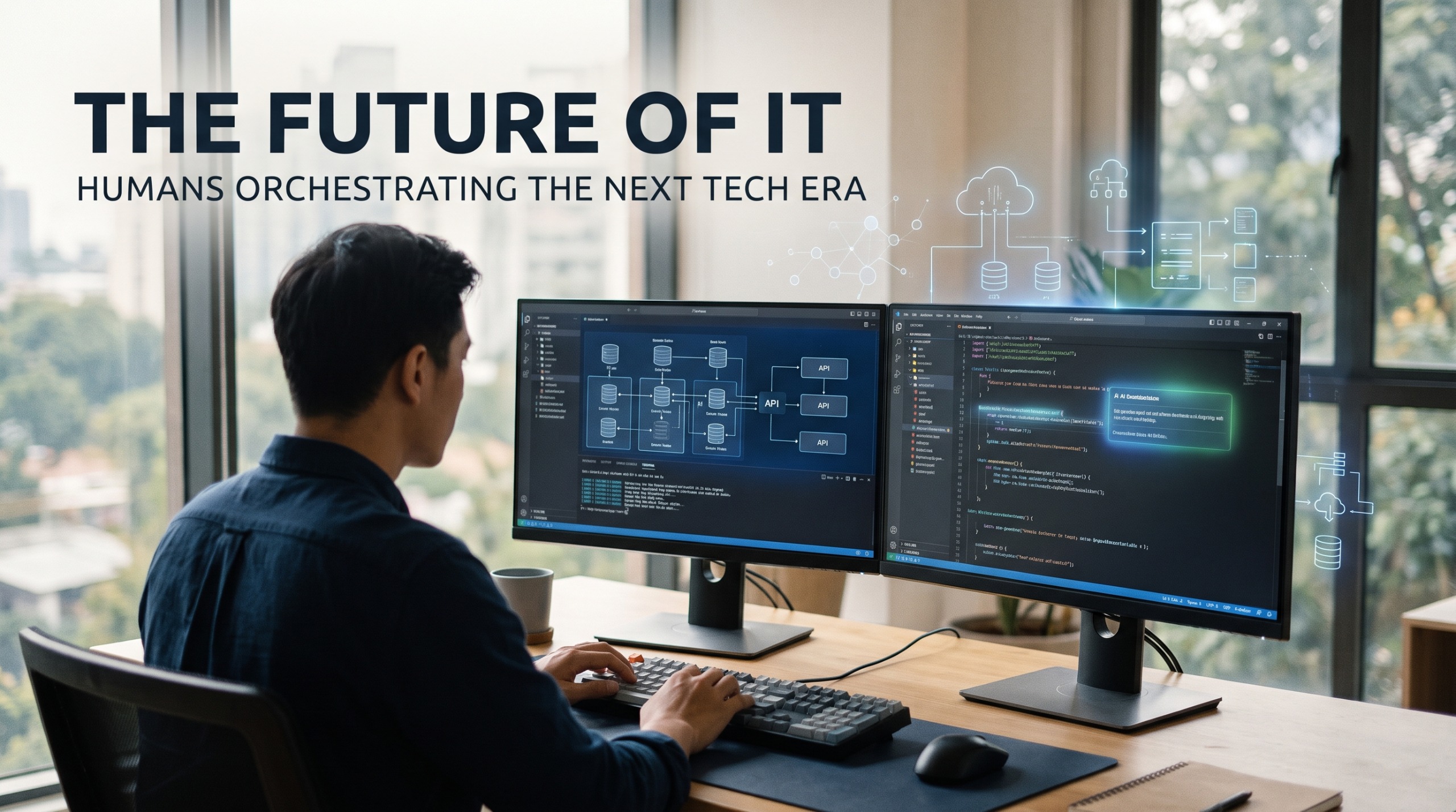
The technology industry is going through its most consequential structural shift in over two decades. For years, the career playbook for developers was remarkably predictable: master a modern JavaScript framework, write REST APIs, stitch together a few database queries, push code to staging, and collect a comfortable paycheck.
That formula is rapidly breaking down.
Writing routine boilerplate syntax is no longer a sustainable career moat because artificial intelligence has turned basic coding into an instant, near-zero-cost commodity. If your primary value proposition as an engineer is translating plain English into routine CRUD functions, you are competing against systems that generate thousands of clean syntax lines in seconds.
The future does not belong to keyboard typists—it belongs to builders and systems orchestrators who know how to solve real architectural problems.
How the Engineering Role Is Fundamentally Changing
Software development is shifting away from typing every line of code by hand. In modern engineering teams, the daily workflow is rapidly moving up the abstraction ladder toward:
- High-Level Systems Architecture: Choosing the right trade-offs between distributed consensus, eventual consistency, and data locality.
- Data Security & Zero-Trust Verification: Designing zero-trust boundaries where every API, service mesh, and database read is verified end-to-end.
- Edge-Case & Failure-Mode Management: Anticipating network partitions, distributed deadlock, and latency spikes under production load.
- Stakeholder Alignment & Product Context: Translating ambiguous business requirements into robust technical specifications that solve the actual commercial bottleneck.
Autonomous AI agents can produce initial pull requests in seconds. What they cannot do is sit in a room with product managers, untangle legacy microservice dependencies, or understand why a distributed banking ledger dropped transactions during a cross-region failover.
Engineers who adapt are becoming system orchestrators. Instead of spending three days writing routine database migrations and standard API controllers, modern engineers design fault-tolerant data pipelines, verify automated CI/CD security gates, and audit model outputs for correctness.
The Three High-Growth Domains for the Next Decade
While generic frontend styling and basic backend scaffolding roles are becoming increasingly crowded, specific technical specializations are seeing unprecedented enterprise demand:
1. Cybersecurity, Defense & Memory Safety
As automated AI scanners make vulnerability discovery orders of magnitude faster, legacy perimeters are collapsing. Organizations desperately need specialists who understand:
- Identity & Access Management (IAM): Role-based and attribute-based security controls across cloud providers.
- Zero-Trust Network Architecture: Service-to-service mutual TLS (mTLS) and cryptographically signed internal requests.
- Memory Safety & Kernel Resilience: Securing low-level runtimes and mission-critical endpoints against nation-state threat vectors.
2. AI Integration & Platform Engineering
Enterprises have moved past the honeymoon phase of toy chatbots. What businesses actually need are senior platform engineers capable of:
- Deploying and running private, cost-effective inference endpoints behind enterprise compliance boundaries.
- Designing low-latency vector retrieval (RAG) pipelines that do not hallucinate across millions of internal documents.
- Hooking transactional databases and ERP backends directly into agentic execution workflows with deterministic guardrails.
3. Distributed Systems, Kubernetes & Infrastructure Economics
Cloud bills remain one of the largest line items on modern balance sheets. The engineers who stand out are those who know how to:
- Scale distributed microservices on Kubernetes without over-provisioning compute resources.
- Manage database connection pooling, caching topologies (Redis/Memcached), and streaming queues (Kafka/RabbitMQ) at high throughput.
- Keep latency budgets strict and reliability high without blowing through annual infrastructure budgets.
The Verdict: Adaptation Over Anxiety
The traditional software developer is not going extinct—it is evolving into something far more impactful.
The engineers who thrive over the next decade will not be the ones who resist AI tools or pretend nothing has changed. They will be the builders who treat AI as a 10x force multiplier, leveraging automated scaffolding so they can focus their human energy where it matters most: solid computer science fundamentals, resilient systems design, and solving real-world business problems.